
Essential Tool Kit for First-Time Homeowners
Heads up: this post contains affiliate links. If you buy through them, we may earn a small commission at no extra cost to you. This is a research-based guide on what to look for, not a hands-on product test. Learn more.
When you move into your first home, the to-do list shows up before the boxes are unpacked. A loose cabinet hinge, a picture that needs hanging, a wobbly towel bar. Having a small, solid tool kit means you can handle those little jobs in ten minutes instead of putting them off for months.
You don't need a garage full of gear. Here's a practical starter kit, in roughly the order we'd buy things, plus what to look for so you don't overspend.
The must-haves
1. A cordless drill/driver
If you buy one power tool, make it this one. You'll use it to drive screws, drill pilot holes, hang shelves, and assemble furniture.
What to look for: a drill/driver (not just a screwdriver) with a clutch so you don't strip screws, a battery and charger included, and a brand whose batteries fit other tools you might want later.
- Look for: cordless drill/driver kit
- Look for: drill and driver bit set
2. A multi-bit screwdriver
For quick jobs, it's faster than grabbing the drill. Look for one that holds Phillips and flat bits in a few sizes.
- Look for: multi-bit screwdriver
3. A claw hammer
A mid-weight claw hammer handles picture nails, small trim fixes, and pulling out old nails. A comfortable grip matters more than a fancy brand.
- Look for: claw hammer
4. A 25-foot tape measure
Measure twice, buy once. A 25-foot tape covers rooms, furniture, and window measurements. Look for a lock button and markings that are easy to read.
- Look for: 25-foot tape measure
5. A level
Crooked shelves and frames drive everyone a little nuts. A 24-inch level covers most household jobs, and a small torpedo level fits in tight spots.
- Look for: 24-inch level
- Look for: torpedo level
6. A stud finder
Heavy shelves, TVs, and curtain rods should go into studs or use the right wall anchors. A basic electronic stud finder takes the guesswork out.
- Look for: stud finder
- Look for: assorted wall anchors
7. Pliers and an adjustable wrench
A pair of slip-joint pliers, needle-nose pliers, and an adjustable wrench will handle loose nuts, faucet supply lines, and bending small things back into shape.
- Look for: pliers set
- Look for: adjustable wrench
8. A utility knife
For opening boxes, scoring drywall, trimming caulk, and a hundred other things. Look for one with a blade lock and spare blades.
- Look for: utility knife with spare blades
The "you'll be glad you have it" tools
9. A plunger and a drain snake
Not glamorous, but you'll want them before you need them. A flange plunger works for toilets, and a simple plastic drain snake helps with hair clogs in sinks and tubs.
- Look for: flange plunger
- Look for: plastic drain snake
10. A caulk gun
Recaulking a tub or sealing a window gap is one of the most useful skills a new homeowner can learn. A basic caulk gun is all you need.
- Look for: caulk gun
11. A non-contact voltage tester
This is a small pen-shaped tool that can alert you if a wire or outlet may be live. It's helpful for simple jobs like swapping a light switch cover. It is not a reason to work inside your electrical panel. Panel work, new circuits, and anything you're unsure about should go to a licensed electrician.
- Look for: non-contact voltage tester
12. A good flashlight or headlamp
Under sinks, in the attic, during a power outage. A headlamp keeps both hands free.
- Look for: LED headlamp
13. Safety gear
Safety glasses, work gloves, and dust masks or respirators rated for the job. Hearing protection if you'll use louder power tools. This stuff is cheap and it protects the only eyes and lungs you've got.
- Look for: safety glasses
- Look for: work gloves
- Look for: dust masks
14. A stepladder
A sturdy stepladder is safer than standing on a chair. Check the weight rating and pick a height that fits your ceilings.
- Look for: stepladder
15. A toolbox or tool bag
Keeping everything in one spot is half the battle. A tool bag with pockets or a simple toolbox with a tray works fine.
- Look for: tool bag
Should you buy a pre-made tool kit?
Pre-made kits can be a good deal for basics like screwdrivers, pliers, and a hammer. What to look for: a sturdy case, tools you'll actually use, and no long list of filler pieces. Many people buy a basic kit and then add a separate drill and a better tape measure.
- Look for: homeowner hand tool kit
Ways to save money on your kit
- Buy as you go. Wait to buy specialty tools until a real project needs them.
- Stick to one battery family. If you buy a cordless drill, picking later tools from the same brand's battery line can save you from buying extra batteries and chargers.
- Borrow or rent the big stuff. Many hardware stores and some libraries rent or lend larger tools you'll only use once.
- Watch the seasonal sales. Tools often go on sale around holidays, so a wish list helps you grab deals when they show up.
- Skip the giant kits with filler pieces. A smaller set of tools you'll actually use beats a huge case of bits you'll never touch.
What to leave to the pros
A tool kit makes small fixes easy, but some jobs need a licensed pro no matter what tools you own: gas lines and gas appliances, anything inside the electrical panel, new wiring, and roof work. Hiring out those jobs is the smart move, not a failure.
Start a simple home binder
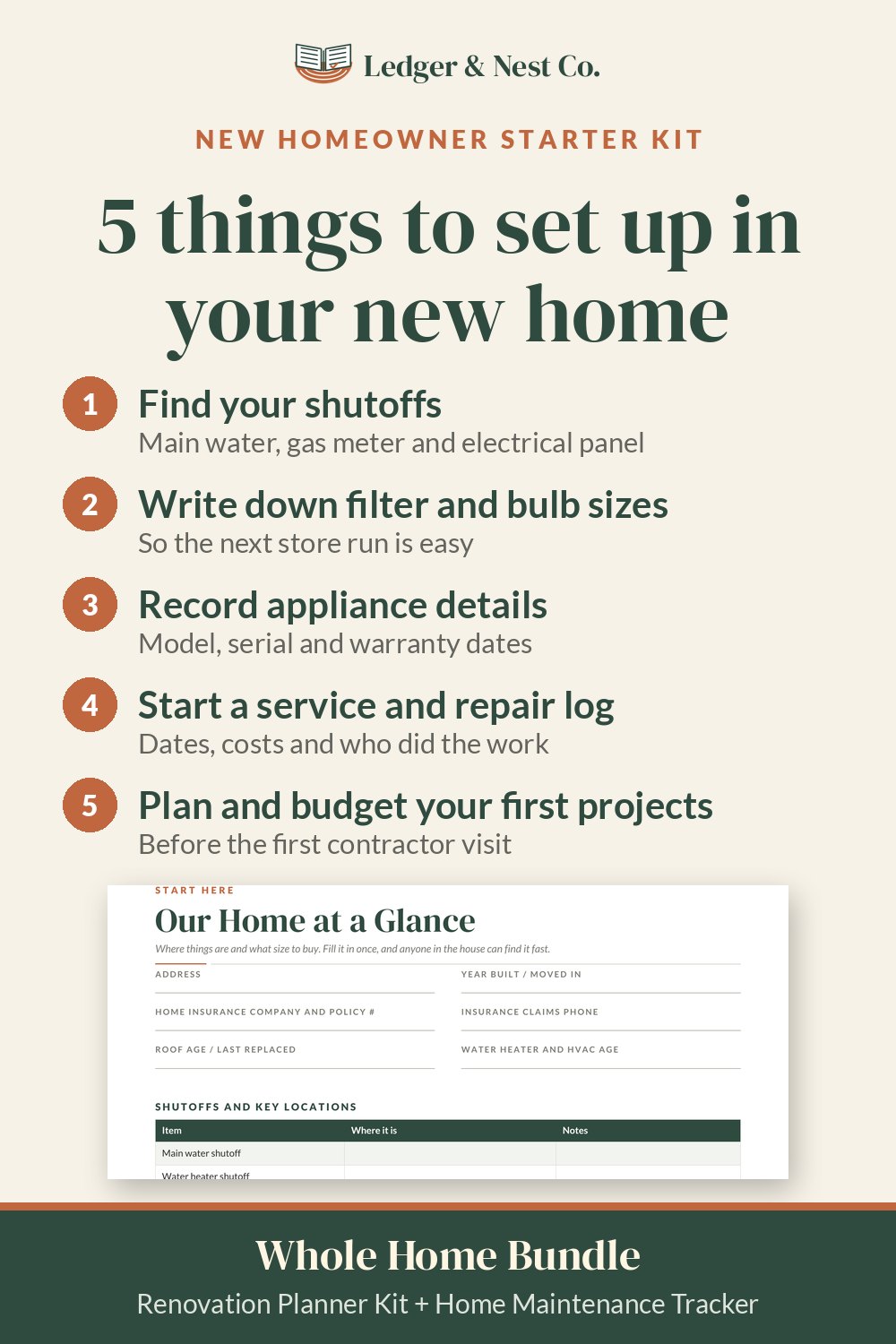
Once you have your tools, the next thing that helps is keeping track of your house: what you fixed, what you bought, what's coming up. We made the Whole Home Bundle for exactly that. It pairs the Renovation Planner Kit with the Home Maintenance Tracker, so your project budgets and your maintenance log live in one place. If that sounds useful, take a look. If not, a notes app works too. Just write it down somewhere.
The short version
Start with a drill, a screwdriver, a hammer, a tape measure, a level, and a stud finder. Add the rest as projects come up. Buy for what you'll really use, and keep it all in one spot.