
Moving Checklist: What to Do 8 Weeks, 4 Weeks and 1 Week Before Moving Day
Heads up: this post contains affiliate links. If you buy through them, we may earn a small commission at no extra cost to you. This checklist is based on research and common moving guidance, not hands-on product testing. Learn more.
A move has a way of turning into one giant to-do list that lives in your head at 2 a.m. The fix is not working harder. It's breaking the list into weeks, so each week has a short, doable set of jobs and nothing important sneaks up on you.
We put this checklist together by week, counting back from moving day. If you have less time than eight weeks, start at the section that matches where you are and do the earlier jobs first.
8 weeks before moving day
Set the date and the budget
Pick your moving date, or a short window if you are waiting on closing or a lease. Then set a total moving budget before you call anyone. Write down the big pieces: movers or a truck, packing supplies, travel, cleaning, deposits for the new place, and a cushion for surprises.
Collect mover or truck quotes
Ask at least three companies for a written quote. Make sure each quote covers the same things so you can compare fairly: the date, how much stuff you have, stairs or long carries at either end, and any packing help. Ask how they handle damage claims and what is and isn't included in the price.
What to look for: a quote in writing, a clear list of extra fees, and proof that the company is licensed and insured for the kind of move you are making.
Start a moving folder
Pick one place for every quote, receipt, contract, and confirmation number. It can be a paper folder, a folder on your phone, or a spreadsheet. You will be glad you did on moving day.
- Look for: accordion file folder
- Look for: label maker
6 to 4 weeks before
Declutter room by room
Every item you get rid of is one you don't have to pack, carry, or unpack. Go room by room and make three piles: keep, donate or sell, and toss. Start with the rooms you use least, like the garage, basement, or guest room.
Order your packing supplies
It's easy to underestimate how many boxes you need. Get more than you think, plus plenty of tape. Small boxes are for heavy things like books, and large boxes are for light things like pillows and linens.
What to look for: sturdy boxes in a few sizes, a tape gun so you are not wrestling with the roll, and labels or colored tape so each room has its own color.
- Look for: moving boxes kit
- Look for: packing tape and dispenser
- Look for: color-coded moving labels
- Look for: packing paper
Book the movers or the truck
Once you have compared quotes, book the one you want and get the confirmation in writing. If you are renting a truck, reserve it early, especially for the end of the month and weekends, which tend to fill up first.
Plan for big and awkward items
Think through the pieces that need extra care: mattresses, sofas, TVs, mirrors, and anything fragile. Moving blankets and furniture sliders help protect floors and furniture, and mattress bags keep a mattress clean in the truck.
- Look for: moving blankets
- Look for: furniture sliders
- Look for: mattress bag
3 to 2 weeks before
Make your change of address list
Write down everyone who needs your new address. Common ones include the post office, your bank and credit cards, your employer, insurance, doctors and dentists, subscriptions, and online stores you use often. Work through the list a few at a time.
Schedule your utilities
Call or go online to set a stop date at your old place and a start date at your new one. Overlap them by a day if you can, so the lights and water are on when you arrive. Common ones are electricity, gas, water, trash, and internet.
Keep the safety jobs with the pros
Some moving jobs are not DIY. Disconnecting or reconnecting a gas stove or gas dryer, relighting pilot lights, and any wiring work, such as hardwired light fixtures, should be done by a licensed professional or your gas utility. If you ever smell gas, leave the home and call your gas utility or 911 from outside.
Start packing the rarely used stuff
Pack out of season clothes, extra linens, books, and decor first. Label every box with the room it goes to and a short list of what's inside. Number the boxes too, so you can tell on moving day if one is missing.
1 week before
Pack an open first box
This is the box you open the first night, so you are not digging through twenty boxes for a toothbrush. Good things to include: phone chargers, toilet paper, soap, towels, a change of clothes, medications, basic tools, a flashlight, snacks, and paper plates.
- Look for: clear storage bin with lid
- Look for: LED flashlight
Confirm everything
Call the movers or the truck rental to confirm the date, the time, and both addresses. Confirm your utility dates. If you need parking space for a truck, check whether your building or street has rules.
Get the kitchen ready
Use up the food in your fridge and freezer. If you are moving a fridge, check the manual for how long it should be unplugged and defrosted before the move.
Set aside important papers and valuables
Keep passports, closing papers, leases, medications, and jewelry with you instead of in the truck.
Moving day
- Do a final walk through of every room, closet, and cabinet.
- Take photos of the meters at your old place and your new place, with the date.
- Check that windows are locked and lights are off.
- Keep your phone charged and your moving folder with you.
- Hand over keys, or arrange how they will be returned.
- Look for: hand truck or dolly
After the move
Once the boxes are in, unpack the kitchen, bathrooms, and bedrooms first, so you can eat, shower, and sleep. Then work room by room. When you are settled, the New Home Checklist covers what to do in your first week, 30 days and 90 days in the new place, like finding your main water shutoff and testing the smoke alarms.
A quick printable version
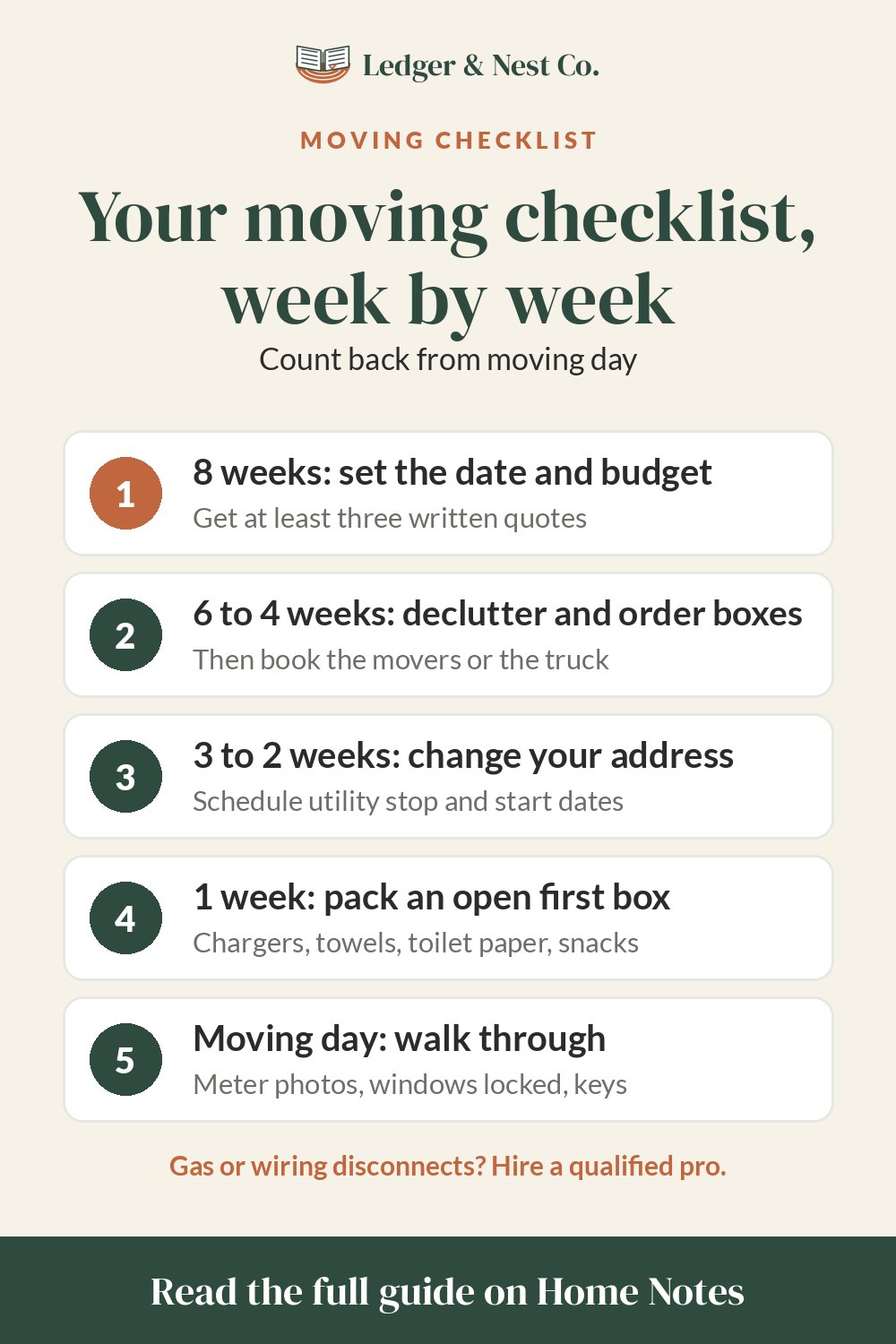
- 8 weeks: set the date and the moving budget
- 8 weeks: get at least three written quotes
- 8 weeks: start a moving folder
- 6 to 4 weeks: declutter room by room
- 6 to 4 weeks: order boxes, tape, and labels
- 6 to 4 weeks: book movers or a truck
- 3 to 2 weeks: make the change of address list
- 3 to 2 weeks: schedule utility stop and start dates
- 3 to 2 weeks: book a pro for any gas or electrical disconnects
- 1 week: pack the open first box
- 1 week: confirm movers, utilities, and parking
- Moving day: walk through, meter photos, keys
Keep the whole move in one place
A move has a lot of moving parts: quotes, deposits, dozens of boxes, and a long list of address changes. We made the Moving Planner and Checklist so all of it lives in one spreadsheet. It comes with 56 moving tasks already sorted by week, plus a moving budget, a box inventory, address changes, utilities, and a movers quote comparison, with 14 printable pages if you like paper. You can find the Moving Planner and Checklist on Etsy. If a notebook works better for you, that's great too. The point is to have one list instead of ten.
The short version
Count back from moving day and give each week a short list. Get quotes early, declutter before you pack, label every box, and keep the gas and electrical jobs with a licensed pro or your utility. Pack an open first box, and your first night in the new place will be a lot calmer.