
New Home Checklist: What to Do in Your First Week, 30 Days and 90 Days
Heads up: this post contains affiliate links. If you buy through them, we may earn a small commission at no extra cost to you. This checklist is based on research and common homeowner guidance, not hands-on product testing. Learn more.
The keys are yours. The boxes are everywhere, the paperwork is in three different places, and you are not quite sure where the water shutoff is. That's normal. Nobody hands you a manual for a house.
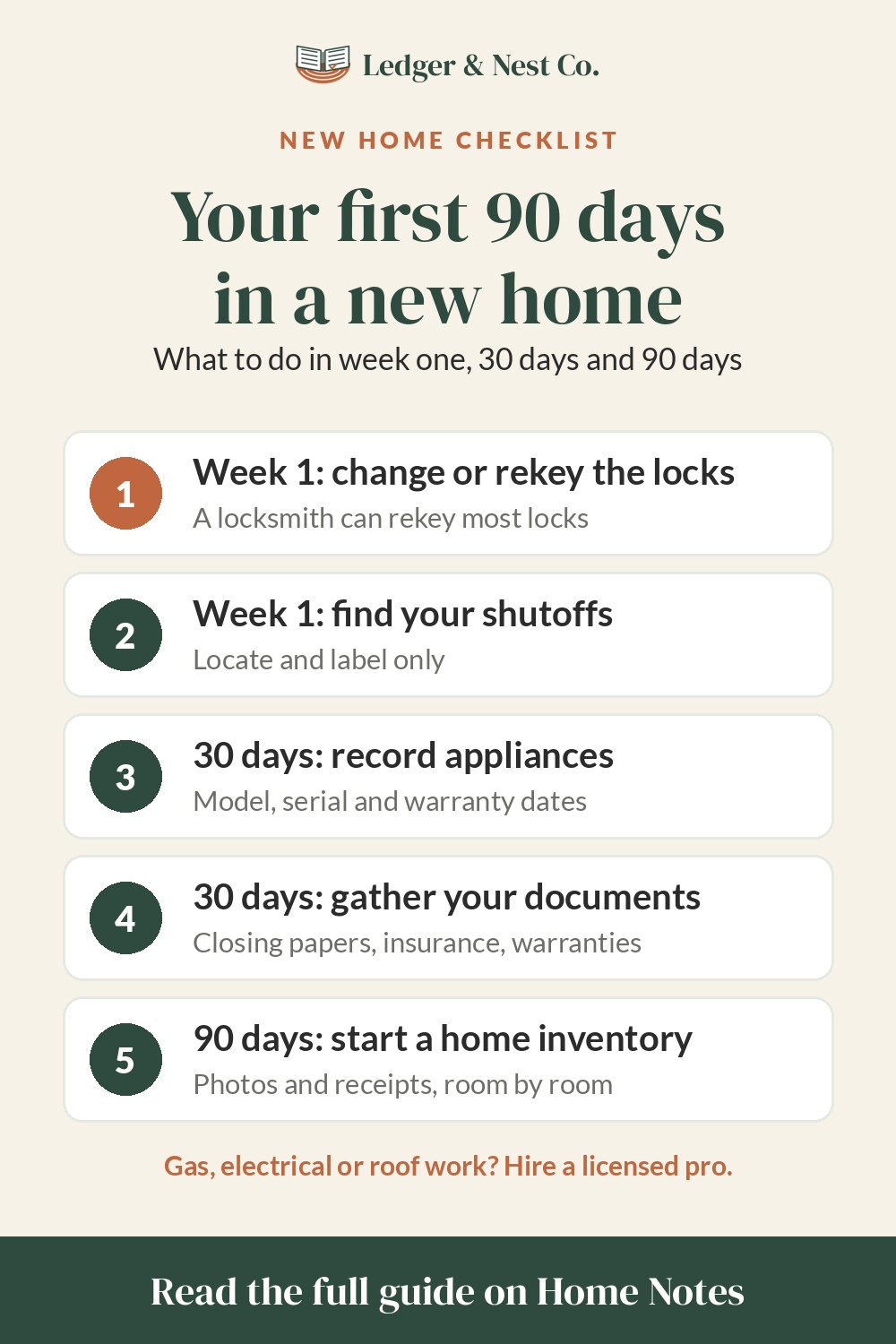
This checklist breaks the first few months into three parts: the first week, the first 30 days, and the first 90 days. You don't have to do it all at once. Start with the safety jobs, then work through the rest as you settle in.
Your first week
Change or rekey the locks
You don't know how many copies of the old keys are out there. Changing the locks, or rekeying them so the old keys no longer work, is one of the first things many new homeowners do. A locksmith can rekey most locks quickly, or you can look for a rekey kit made for your lock brand.
- Look for: lock rekey kit
- Look for: keyed alike deadbolt set
Find your shutoffs (locate and label only)
In an emergency, you want to know exactly where to go. Find these now and label them so anyone in the house can find them fast:
- Main water shutoff. Often in the basement, a utility room, or near where the water line comes into the house. Check that you can reach it. If the valve is stuck or leaking, call a licensed plumber rather than forcing it.
- Electrical panel. Find it and check whether the breakers are labeled. That's as far as DIY goes. Anything inside the panel is a job for a licensed electrician.
- Gas meter and shutoff. Know where it is, but leave it alone. If you ever smell gas, leave the home now and call your gas utility or 911 from outside.
- Look for: valve tags
- Look for: label maker
Test the smoke and carbon monoxide alarms
Press the test button on every alarm. Replace the batteries, and check the manufacture date on the back, since alarms don't last forever. If you have any fuel burning appliances or an attached garage, carbon monoxide alarms matter a lot. Make sure there is a fire extinguisher in the kitchen and that everyone knows where it is.
- Look for: combination smoke and CO alarm
- Look for: kitchen fire extinguisher
Set up your utilities and accounts
Make sure electricity, water, gas, trash, and internet are in your name. Write down each company, the account number, and how to reach them. Do the same for your homeowners insurance and, if you have one, your homeowners association.
Your first 30 days
Record your appliances and warranties
For each appliance, write down the brand, model number, serial number, install or purchase date, and how long the warranty lasts. The model and serial numbers are usually on a sticker inside the door, on the back, or underneath. Taking a photo of each sticker is a quick way to do it. Register any appliances that are still under warranty, and keep the manuals in one place.
Gather your closing papers and home documents
Put your closing papers, deed, mortgage documents, homeowners insurance policy, survey, inspection report, and any warranties in one safe place. A fireproof document box or safe is worth considering. Make a simple list of what you have and where each one is kept.
- Look for: fireproof document box
- Look for: binder and sheet protectors
Write down your paint colors
If the sellers left paint cans behind, write down the brand, color name, color code, and finish for each room before the labels fade. If they didn't, a paint store can often match a color from a small chip. This saves a lot of guesswork for touch ups later.
Change the furnace filter
Pull out the current filter and write down the size printed on the edge. Replace it, and buy a few spares in that exact size. Your system's manual will say how often to change it.
- Look for: furnace filters in your size
Get to know the house
Walk around inside and out. Look under the sinks for drips, check the water heater area, and note anything you want a pro to look at. Your inspection report is a good guide to what to watch.
Your first 90 days
Start a home inventory
A home inventory is a list of what you own, with photos, approximate values, and receipts where you have them. It can help if you ever need to make an insurance claim. Start with the most valuable things: electronics, furniture, jewelry, and appliances. Walking through each room with your phone's camera is an easy first pass.
Build your list of service pros
Before something breaks, start a list of local pros: a plumber, an electrician, an HVAC company, a roofer, a handyman, and a locksmith. Ask neighbors who they use, and keep each name with a phone number and notes on any work they've done.
Plan your first year budget
The first year in a home often brings costs you didn't plan for: window coverings, tools, furniture, a lawn mower, and repairs. Make a simple budget for the year, with a planned amount for each category, and track what you actually spend.
Set up a maintenance schedule
Houses need regular care. Make a list of the jobs that repeat, like changing filters, testing alarms, and cleaning gutters, and when each one is due. The Fall Home Maintenance Checklist and How to Winterize Your Home posts are good seasonal starting points, and the Home Maintenance Checklist lays out a month by month schedule.
If you are still building your basic tools, the Essential Tool Kit for First-Time Homeowners walks through the basics.
Leave these to a licensed pro
- Anything with gas lines or gas appliances
- Work inside the electrical panel, or any new wiring
- Roof repairs, or anything that means climbing on the roof
- Plumbing inside walls or under floors, and any valve that is stuck or leaking
A quick printable version
- Week 1: change or rekey the locks
- Week 1: locate and label the water shutoff, electrical panel, and gas meter
- Week 1: test smoke and CO alarms, check the fire extinguisher
- Week 1: put utilities and accounts in your name
- 30 days: record appliance model and serial numbers and warranties
- 30 days: gather closing papers and home documents in one place
- 30 days: write down paint colors
- 30 days: change the furnace filter and note the size
- 90 days: start a home inventory
- 90 days: build your list of service pros
- 90 days: plan your first year budget
- 90 days: set up a maintenance schedule
Keep your home's records in one place
We made the New Homeowner Binder for this exact stretch of time. It's a spreadsheet for Google Sheets and Excel with 13 tabs for house info, contacts, utilities and accounts, paint and finishes, appliances and warranties, a documents index, closing and mortgage details, emergency shutoffs, a home inventory, and a first year budget. It comes with 34 starter tasks for your first week, 30 days and 90 days, plus 14 printable pages. You can find the New Homeowner Binder on Etsy. If a paper folder works better for you, that's great too. The point is to have one place for everything about your home.
The short version
In week one, focus on safety: locks, shutoffs, and alarms. In the first month, get your records together: appliances, documents, paint colors, and the filter size. By 90 days, start a home inventory, find your pros, and set up a budget and a maintenance schedule. Leave gas, electrical, roof, and in-wall plumbing work to a licensed pro.